Introduction
Primary brainstem hemorrhage refers to spontaneous brainstem hemorrhage that excludes traceable secondary factors such as trauma, vascular malformation, and tumor. In the untraceable PBSH, most of them are accompanied by hypertensive diseases, which are often called hypertensive brainstem hemorrhage, and are the most lethal subtypes of hypertensive intracerebral hemorrhage. Despite significant advances in the surgical and management of PBSH, mortality remains high ranging from 30% to 80% according to different studies, even approaching 100% for severe PBSH [1,2].
The therapeutic approaches and predictive elements associated with primary brainstem hemorrhage are distinctly dissimilar to those encountered in other categories of primary intracerebral hemorrhage, including supratentorial hemorrhage and hemorrhages in the cerebellum. Currently, PBSH was managed with conservative treatment and neurosurgical interventions continue to be controversial because randomized clinical studies have failed to demonstrate a clear benefit to surgical management. Previous research has indicated that both the size of the hemorrhage and the Glasgow Coma Scale score could serve as independent predictors for unfavorable outcomes in patients suffering from PBSH [3]. The adverse prognostic effect of hyperglycemia in other subtypes of primary intracerebral hemorrhage has been confirmed [4,5], but its role in primary brainstem hemorrhage remains to be clarified.
The purpose of this study was to retrospectively review 75 cases of PBSH admitted to our hospital to investigate the risk factors of poor prognosis and the association between hyperglycemia and short-term functional outcome.
Methods
Study design
Using a retrospective, observational, and single center study design, we aimed to explore the prognostic factors in patients with PBSH. This study was conducted with the approval of the Ethics Committee of The First Hospital of Putian City, Fujian Province. Due to the retrospective, observational nature of this study and the anonymity of patients, the need for informed consent was waived.
Patient selection
We retrospectively reviewed the data of 75 patients with PBSH admitted to our institution between January 2018 and December 2020. The inclusion criterion was a diagnosis of PBSH verified by Computer Tomography (CT) and admitted within 24 hours after symptoms onset. Patients aged <18 or >80 years, secondary to trauma, vascular malformation, and tumor were excluded.
Candidate variables
Medical records were carefully reviewed to obtain the following information: age, gender, Glasgow Coma Scale (GCS) score, medical history (hypertension, Diabetes Mellitus (DM), Mean Arterial Pressure (MAP), admission biochemical blood glucose, White blood cell count (WBC), Neutrophil-to-Lymphocyte Ratio (NLR), Platelet count, Biochemical serum calcium levels, and hematoma characteristics (size and Intraventricular Hemorrhage (IVH). Emergent computed tomography was performed within 24 hours of onset. The size of hematoma was measured and expressed as the lesion equivalent diameter a*b*c/2, where a, b, and c represent the longest diameter of the hematoma layer with the largest area in the axial cuts, the diameter perpendicular to the longest diameter mentioned and the thickness of the hematoma, respectively.
Outcome evaluation
We defined short-term functional outcome as functional outcome at discharging by assessing the Modified Rankin Scale (mRS), which modified Rankin Scale score of 0 to 2 regarded as a favorable outcome and 3 to 6 as a poor outcome.
Statistical analysis
Statistical analysis was performed using SPSS 21.0 (IBM Institute, Inc, Chicago, IL). P< 0.05 was considered as significant differently. Measurement data were checked for a normal distribution, by the Kolmogorov-Smirnov test. Continuous variables were expressed as mean ±SD or median with Interquartile Range (IQR) (25th-75th percentile). Categorical variables were presented as numbers and percentages. Univariate analyses of related clinical variables were conducted using the χ2 test, Fisher exact test, independent t test, and Mann-Whitney U test where appropriate. Multicollinearity was assessed via Variation Inflation Factors (VIF), and VIF≥10 was considered significant. A logistic regression model was used to determine the effect of variables on outcome. Only variables with P<0.05 on univariate analysis were incorporated into the multivariate logistic regression model. Receiver Operating Characteristic (ROC) analysis was undertaken to determine the threshold of critical hyperglycemia for short-term functional outcome.
Results
Patients
Among the 75 patients, 56(74.7%) were male, and the average age was 56.9±11.4 years, ranging from 33 to 85 years. There were 7 patients (9.3%) with DM. Upon admission, the average blood glucose level was 7.9±3.0 mmol/L. IVH and GCS score< 8 was presented in 45(60.0%) and 28(37.3%) of patients, respectively. The median size of the hematoma was 2.59 mL, with an Interquartile Range (IQR) of 0.84 to 5.25 mL. The incidence of poor functional outcome at discharging was 64.0%. The detailed information on baseline characteristics and variables is listed in Table 1. No significant col-linearity was observed between characteristics and variables.
Uni-variate analysis of factors related to outcome
Uni-variate analysis revealed that patients with poor functional outcome were younger (P=0.048), had significantly higher admission blood glucose levels (P=0.04), lower GCS scores (< 8 points, P< 0.001), larger hematoma sizes (P< 0.001), and higher white blood cell counts (P=0.009). However, MAP, NLR, serum calcium, platelet count, and the presence of hypertension, IVH and DM were not associated with poor outcome (Table 1).
Multivariate analysis of factors associated with outcome
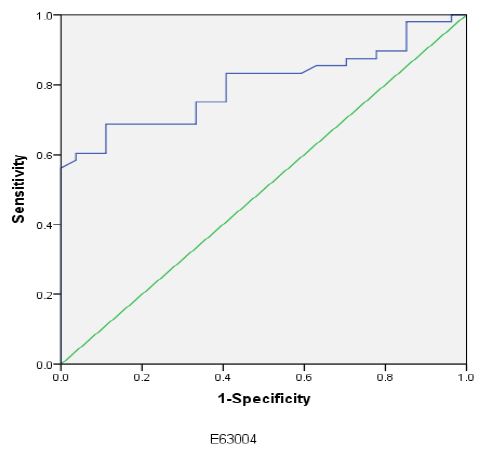
Multivariate logistic regression analysis of all patients showed that hyperglycemia (OR 1.65, 95% CI 1.07-2.55, P=0.024) and GCS< 8 (OR 0.1, 95% CI 0.01-0.94, P=0.04) were significant independent predictors of poor functional outcome in short-term (Table 2). A ROC curve showed that an admission blood glucose >7.49mmol/L predicted short-term functional outcome of PBSH patients with 68.8% sensitivity, 89.9% specificity, and area under the curve 0.80 (Figure 1).
Table 1: Baseline characteristics and variables related to short- term functional outcome in patients with PBSH.
| Factors |
Total(n=75) |
Outcome |
| Favorable(n=27) |
Poor(n=48) |
P |
| Demographic |
| Age (year) |
56.9±11.4 |
59.5±13.4 |
55.5±10.0 |
0.048 |
| Male(n, %) |
56 (74.7) |
20(74.1) |
36(75.0) |
0.93 |
| Clinical data |
| Hypertension (n,%) |
67(89.3) |
25(92.6) |
42(87.5) |
0.49 |
| Diabetes mellitus (n, %) |
7 (9.3) |
1(3.7) |
6(12.5) |
0.21 |
| MAP(mmHg) |
129.1±56.9 |
129.8±23.7 |
128.7±23.2 |
0.85 |
| GCS score<8 (n, %) |
28(37.3) |
1(3.7) |
27(56.3) |
0 |
| Laboratory Findings |
| Blood glucose(mmol/L) |
7.9±3.0 |
6.2±1.2 |
8.9±3.3 |
0.004 |
| Serum calcium (mmol/L) |
2.2±0.1 |
2.2±0.1 |
2.1±0.1 |
0.785 |
| WBC (10^9/L) |
10.7(8.7,14.9) |
10.1(9.6,11.3) |
11.7(9.5,16.9) |
0.009 |
| NLR |
5.7(3.4,9.7) |
5.3(3.0,8.7) |
6.0(3.5,11.6) |
0.323 |
| Platelet (109/L) |
223.9±81.2 |
213.7±57.2 |
230±92.1 |
0.071 |
| Radiological data |
| Hematoma volume(ml) |
2.6(0.84,5.3) |
0.9(0.4,1.4) |
4.2(2.0,8.2) |
0 |
| Presence of IVH (n, %) |
45(60.0) |
19(25.3) |
26(34.7) |
0.17 |
Table 2: Predictors of functional outcome in short-term in patients
with PBSH in multiple logistic regression.
| Factors |
OR |
95% CI |
P value |
| Blood glucose |
1.65 |
1.07-2.55 |
0.024 |
| White bloodcell count |
1.01 |
0.86-1.17 |
0.95 |
| Hematoma volume |
1.4 |
0.95-2.07 |
0.09 |
| GCS score<8 |
0.1 |
0.01-0.94 |
0.04 |
| Age |
1.01 |
0.95-1.07 |
0.79 |
Discussion
Epidemiology
Cerebral hemorrhage can be categorized into two primary types based on the location of the bleeding: supratentorial hemorrhage and infratentorial hemorrhage. The supratentorial cerebral hemorrhage typically targets the basal ganglia, whereas spontaneous infratentorial hemorrhages are largely made up of spontaneous cerebellar hemorrhages and PBSH. Previous studies have indicated that males have a higher proportion in PBSH [1,2,6], and this study also reveals a higher composition ratio of males, at 74.7%. The reason why the proportion of males is higher is not clear, but it is conjectured that this could be associated with males possessing more risk elements and catalysts [7]. Nonetheless, it is important to note that gender does not serve as a prognostic indicator, one feasible explanation could be that should a brainstem hemorrhage arise, due to its high mortality rate, the clinical outcomes do not exhibit a marked discrepancy [3].
Compared to primary hemorrhages in the supratentorial region and cerebellum, there is an observable trend of PBSH occurring in a younger demographic [8]. In this study, patients diagnosed with PBSH were generally younger, and those experiencing poor short-term functional outcome were younger than their counterparts with good outcome. We speculate that the underlying causes may be associated with factors including the intense competitive pressures of contemporary society, the rapid pace of daily life, and prolonged states of suboptimal health, which contribute to the exacerbation of illnesses once they occur.
Clinical factors associated with outcome
In untraceable PBSH, hypertension frequently presents as a comorbidity. The findings of this study suggest that there is no statistically significant disparity in the prevalence of hypertension and MAP levels at admission between the two groups with poor and favorable short-term functional outcome. Nevertheless, the comorbidity rate of hypertension reached a high level of 90% in both groups of patients, indicating that hypertension is a critical factor in the initiation and worsening of PBSH, hence stringent blood pressure management should be prioritized in the therapeutic regimen. Research suggests that adopting an aggressive approach to blood pressure reduction in the initial phases [9-11], namely swiftly and smoothly decreasing blood pressure to under 140/90 mmHg during the acute phase and sustaining this level for a week, can significantly curb the enlargement of hematoma, thus enhancing the patient’s prognosis.
Patients diagnosed with PBSH exhibiting a Glasgow Coma Scale (GCS) score below 8 are considered to be in a coma state, indicating that the acute increase in intracranial pressure caused by the primary injury (mass effect of hematoma), secondary injury (brain edema), or acute hydrocephalus (blood in the ventricles) has widely affected the ascending reticular activating system of the brainstem. Previous research has indicated that the Glasgow Coma Scale (GCS) score serves as an independent predictor of adverse outcomes in patients with PBSH [1,12-15]. Our research further reveals that a GCS score below 8 is an independent risk factor for poor short-term functional outcome in patients with PBSH.
Laboratory evaluation
Calcium (Ca+) as the most abundant mineral element in the human body, plays a crucial role in maintaining the stability of the nervous system and the blood-brain barrier. Epidemiological studies indicate that individuals with low calcium intake are at a greater risk of developing hypertension [16], suggesting that calcium might play a crucial role in the regulation of blood pressure. Research conducted on experimental animals suggests that rats experiencing inadequate calcium consumption exhibit markedly prolonged clotting times [17]. This is because calcium is essential to the coagulation process, where it facilitates the activation of tissue factor and bolsters the adhesion capabilities of platelets [18]. Calcium plays a crucial regulatory role in the occurrence and development of cerebral hemorrhage [19]. Meta-analysis suggests that hypocalcemia [20], acting as an independent risk factor for poor outcome in intracerebral hemorrhage, could result in hematoma expansion. This, in turn, impacts neurological recovery and quality of life, leading to a more severe outcome. This study revealed that patients with poor outcome PBSH exhibited lower blood calcium levels compared to those with a more favorable outcome, aligning with the results of prior basic and clinical research. However, the disparity between the two groups failed to attain statistical significance, suggesting that additional large-scale data studies are required to corroborate these results.
Following a cerebral hemorrhage, the body’s immune system is activated, initiating a series of inflammatory responses. From a biological viewpoint, a rise in the white blood cell count suggests the triggering of immune system inflammation reflects the equilibrium between inflammatory processes and regulatory mechanisms, providing a comprehensive indication of the body’s immune-inflammatory status. A higher NLR value typically signifies a more severe condition [2].
Hyperglycemia, a prevalent clinical symptom, manifests in a range of pathological conditions, including cerebrovascular accidents. It is a modifiable risk factor that can be managed through insulin injections or the administration of antidiabetic medications. Therefore, hyperglycemia has consistently been a focal point for researchers. Numerous studies suggest that hyperglycemia results in poorer outcomes and elevated mortality rates among patients suffering from cerebral hemorrhage [21-24]. Nevertheless, these investigations predominantly concentrate on supratentorial and cerebellar hemorrhages, with a comparatively scant number addressing PBSH. In line with previous studies, our research suggests that hyperglycemia upon admission serves as an independent predictor of adverse short-term functional outcome in patients diagnosed with PBSH, with a critical threshold of 7.49 mmol/L. This indicates that we ought to enhance the surveillance and regulation of blood glucose levels throughout the treatment regimen. While our research suggests no significant correlacorrelation between a history of diabetes and the study outcomes, given that diabetes could potentially act as a confounding variable, it remains imperative to conduct studies with larger sample sizes.
Research indicates that hyperglycemia can induce brain damage via mechanisms that may subsequently result in unfavorable clinical outcomes [5,25,26]. Initially, hyperglycemia leads to an elevated osmotic pressure, thereby aggravating cerebral edema. Secondly, the substantial quantities of amino acids, nitric oxide, and nitrites generated during glucose metabolism may lead to neuronal swelling and neuronal apoptosis. Finally, hyperglycemia also impairs vascular endothelium, disrupting the blood-brain barrier and resulting in the enlargement of hematomas. The significant impact of hematomas leads to circulatory disturbances in brain tissue, resulting in inadequate cerebral perfusion and inducing a state of hypoxia and ischemia within the brain. The accumulation of metabolic byproducts further exacerbates cerebral edema.
Radiological factors related to outcome
In the field of radiology, PBSH predominantly affects the pons region. Given that the pons is situated at the brainstem’s core, its significant size and abundance of blood vessels render these vessels particularly vulnerable to high blood flow pressures and mechanical forces. Consequently, they are more prone to variations in blood pressure and injuries to the vascular walls, which can result in vessel rupture and hemorrhaging. Additionally, bleeding in the medulla often results in severe respiratory and circulatory disorders, and patients frequently pass away before reaching the hospital, unable to receive medical treatment. Therefore, pontine hemorrhage is the most common type of hemorrhage, while the incidence of medullary and midbrain hemorrhages is relatively low.
The brainstem, which is deeply ensconced within the skull and possesses a relatively small volume, typically experiences hemorrhage that is significantly less extensive than that of supratentorial bleeding. Nonetheless, the damage it inflicts is frequently far more catastrophic. Consistent with previous studies [2], our findings reveal that hematoma volume is an independent risk factor for poor short-term functional outcome in PBSH. Theoretically, the complete evacuation of a hematoma is beneficial in minimizing its detrimental effects on brain tissue, in alleviating intracranial pressure, and in preserving the unobstructed circulation of cerebrospinal fluid. Nonetheless, neurosurgical interventions, including craniotomy for hematoma evacuation, remain a subject of debate, as clinical randomized studies have not yet unequivocally shown significant benefits from surgical intervention. However, with the ongoing evolution of neurosurgical micro techniques and medical imaging technologies, along with their associated equipment, study have indicated the efficacy of surgical treatment [27,28], suggesting that it can lower the mortality rate among patients with PBSH. Research has indicated that the hematoma threshold for PBSH neurosurgical intervention is between 4 to 5 ml. Nevertheless, the conventional method of microhematoma evacuation through craniotomy may elevate the risk of brain tissue damage [1,29]. Recent study has revealed that robot-assisted brainstem hematoma puncture drainage therapy for PBSH facilitates neurological recovery and underscores its safety and efficacy [6]. This indicates that minimally invasive and high-precision puncture drainage could be a promising therapeutic approach. Nonetheless, multicenter, prospective studies remain necessary to further validate.
Limitations
There are several limitations in the current research. Firstly, PBSH accounts for 6%-10% of all instances of ICH [30], a factor that dictates the relatively limited sample size of this investigation. The research data has been sourced from a single center, rather than a multicenter collaboration, which could potentially restrict the broad applicability of the study’s findings. However, considering that this group of cases did not receive surgical intervention, they appear to represent the natural progression of PBSH. Furthermore, we observe that the post-discharge outcomes for patients with PBSH are typically not directly attributable to brainstem hemorrhage itself, but rather to severe complications such as infections, including pneumonia and catheter-associated urinary tract infections. The outcomes are subject to a range of confounding factors, including airway management, nutritional support, the standard of care, and rehabilitation treatment, to name but a few. Thus, we define the outcome of our study as the mRS score at discharge. To evaluate the outcome of PBSH with greater objectivity, it is imperative that we undertake extended follow-up observations. Secondly, the demographic characteristics, clinical data, laboratory test results, and radiological indicators chosen for this study were established in accordance with our observations in clinical practice and insights from previous research literature. Consequently, certain factors that could influence outcomes may not have been identified. To enhance the precision of our research, we intend to incorporate a greater number of patient samples and additional research variables in forthcoming explorations. Thirdly, the absence of samples from the hypoglycemia group complicates our ability to precisely evaluate the impact of hypoglycemia on PBSH. Theoretically, one should prevent the onset of hypoglycemia; however, under conditions of human stress, physiological hypoglycemia is exceedingly rare. We hypothesize that during pathological states, hyperglycemia may manifest in varying intensities of “high” and “low,” potentially exerting distinct effects on clinical outcomes. Consequently, there is a need for more stratified data to substantiate and verify this supposition.
Conclusion
In summary, retrospective analysis of single-center PBSH data has identified several factors correlated with adverse functional outcomes in the short term. These include younger age of patients, hyperglycemia at admission, a Glasgow Coma Scale (GCS) score below 8 upon admission, increased hematoma sizes, and elevated white blood cell counts. Notably, both hyperglycemia at admission and a GCS score below 8 have been identified as independent risk factors for poor short-term functional outcome in patients with PBSH.
Declarations
Ethics approval and consent to participate: This study was approved by the Ethics Committee of the First Hospital of Putian City (Date: 2024-08-24; Number: 2024-145). The requirements for informed consent were waived since there were no concerns regarding patients interests or privacy.
Credit authorship contribution statement: Mingcong Li: Data curation; Formal analysis; Investigation; Methodology; Writing – original draft. Guolin She: Methodology; Conceptualization. Shilong Fu: Writing-review & editing. Hao Xu: Formal analysis. Guofeng Wang: Supervision. Qingdong Jin: Investigation.
Funding: This research did not receive any specific grant from funding agencies in the public, commercial, or not-for-profit sectors.
Declaration of competing interest: The authors declare that they have no conflict of interest.
References
- Huang K, Ji Z, Sun L, et al. Development and Validation of a Grading Scale for Primary Pontine Hem-orrhage. Stroke. 2017; 48: 63-69.
- Geng Y, Wang T, Liu Y, et al. How to predict the outcome of primary brainstem hemorrhage: Six-year results of a single-center retrospective analysis. Medicine (Madr). 2023; 102: e35131.
- Zhou J, Wang R, Mao J, et al. Prognostic models for survival and consciousness in patients with pri-mary brainstem hemorrhage. Front Neurol. 2023; 14.
- Li G, Wang S, Xiong Y, et al. Higher fasting blood glucose was associated with worse in‐hospital clinical outcomes in patients with primary intracerebral hemorrhage: From a large‐scale nationwide longitudi-nal registry. CNS Neurosci Ther. 2022; 28: 2260-2267.
- Gong Y, Wang Y, Chen D, Teng Y, Xu F, Yang P. Predictive value of hyperglycemia on prognosis in spontaneous intracerebral hemorrhage patients. Heliyon. 2023; 9: e14290.
- Bao D, Ni S, Chang B, Zhang W, Zhang H, Niu C. Short-term outcomes of robot-assisted minimally invasive surgery for brainstem hemorrhage: A case-control study. Heliyon. 2024; 10: e25912.
- Wessels T, Moller-Hartmann W, Noth J, Klo C. CT Findings and Clinical Features as Markers for Pa-tient Outcome in Primary Pontine Hemorrhage. AJNR Am J Neuroradiol. 2004; 25: 257-260.
- Chen D, Tang Y, Nie H, et al. Primary Brainstem Hemorrhage: A Review of Prognostic Factors and Sur-gical Management. Front Neurol. 2021; 12.
- Sato S, Carcel C, Anderson CS. Blood Pressure Management After Intracerebral Hemorrhage. Curr Treat Options Neurol. 2015; 17.
- Engl N. Rapid blood pressure lowering may improve haemorrhagic stroke outcomes. BMJ. 2013; 346: f3584-f3584.
- Morgenstern LB, Hemphill JC, Anderson C, et al. Guidelines for the Management of Spontaneous In-tracerebral Hemorrhage. Stroke. 2010; 41: 2108-2129.
- Chen Y, Wang L, Zhang J, et al. Monitoring of patients with brainstem hemorrhage: A simultaneous study of quantitative electroencephalography and transcranial Doppler. Clin Neurophysiol. 2021; 132: 946-952.
- Matsukawa H, Shinoda M, Fujii M, Takahashi O, Murakata A. Risk factors for mortality in patients with non-traumatic pontine hemorrhage. Acta Neurol Scand. 2014; 131: 240-245.
- Jang JH, Song YG, Kim YZ. Predictors of 30-day Mortality and 90-day Functional Recovery after Primary Pontine Hemorrhage. J Korean Med Sci. 2011; 26: 100.
- Dziewas R, Kremer M, Lüdemann P, Nabavi DG, Dräger B, Ringelstein EB. The Prognostic Impact of Clinical and CT Parameters in Patients with Pontine Hemorrhage. Cerebrovasc Dis. 2003; 16: 224-229.
- Chen Y, Strasser S, Cao Y, Wang KS, Zheng S. Calcium intake and hypertension among obese adults in United States: associations and implications explored. J Hum Hypertens. 2015; 29: 541-547.
- Versteeg HH, Heemskerk JWM, Levi M, Reitsma PH. New Fundamentals in Hemostasis. Physiol Rev. 2013; 93: 327-358.
- Sun J, Liu W, Zhu R, Wu Y, Yang L. The relationship between low serum calcium level and intracerebral hemorrhage hematoma expansion. Medicine (Madr). 2020; 99: e18844.
- Sunkara A, Raizner A. Supplemental Vitamins and Minerals for Cardiovascular Disease Prevention and Treatment. Methodist Debakey Cardiovasc J. 2019; 15: 179.
- Chen L, Ma H, Zhang B. Can baseline serum calcium levels predict outcomes of intracerebral hemor-rhage? A systematic review and meta-analysis. J Clin Neurosci. 2024; 126: 164-172.
- Béjot Y, Aboa-Eboulé C, Hervieu M, et al. The Deleterious Effect of Admission Hyperglycemia on Sur-vival and Functional Outcome in Patients with Intracerebral Hemorrhage. Stroke. 2011; 43: 243-245.
- Tao C, Hu X, Wang J, You C. Effect of Admission Hyperglycemia on 6-Month Functional Outcome in Patients with Spontaneous Cerebellar Hemorrhage. Med Sci Monit. 2017; 23: 1200-1207.
- Koga M, Yamagami H, Okuda S, et al. Blood glucose levels during the initial 72h and 3-month func-tional outcomes in acute intracerebral hemorrhage: The SAMURAI–ICH study. J Neurol Sci. 2015; 350: 75-78.
- Kimura K, Iguchi Y, Inoue T, et al. Hyperglycemia independently increases the risk of early death in acute spontaneous intracerebral hemorrhage. J Neurol Sci. 2007; 255: 90-94.
- Aleman L, Guerrero J. Hiperglicemia por sepsis: del mecanismo a la clínica. Rev méd Chile. 2018; 146: 502-510.
- Scheen M, Giraud R, Bendjelid K. Stress hyperglycemia, cardiac glucotoxicity, and critically ill patient outcomes current clinical and pathophysiological evidence. Physiol Rep. 2021; 9.
- Chen LH, Li FJ, Zhang HT, Chen WJ, Sun K, Xu RX. The microsurgical treatment for primary hyper-tensive brainstem hemorrhage: Experience with 52 patients. Asian J Surg. 2021; 44: 123-130.
- Wang Q, Guo W, Liu Y, et al. Application of a 3D-Printed Navigation Mold in Puncture Drainage for Brainstem Hemorrhage. J Surg Res. 2020; 245: 99-106.
- Behrouz R. Prognostic factors in pontine haemorrhage: A systematic review. Eur Stroke J. 2018; 3: 101-109.
- Flaherty ML, Woo D, Haverbusch M, et al. Racial Variations in Location and Risk of Intracerebral Hemorrhage. Stroke. 2005; 36: 934-937.